


Lamphun Day Trip: Exploring the Ancient Hariphunchai Kingdom
Discover Lamphun, the ancient Hariphunchai kingdom. A perfect day trip from Chiang Mai featuring golden temples, longan noodles, and history.
CHIANG MAI OLD TOWN AND TRAVEL TIPS
12/20/20256 min read


Exploring Lamphun: A Perfect Day Trip to a Historic, Ancient Kingdom
Chiang Mai, the "New City," was founded in 1296. To us, that seems incredibly ancient. But just 30 kilometers to the south lies a city that makes Chiang Mai look like a youngster.
This is Lamphun.
Founded in the 7th Century (around 660 AD) by the legendary Queen Chamadevi, Lamphun was originally known as Hariphunchai. It was a thriving center of Mon culture, art, and Buddhism long before the Lanna Kingdom even existed.
For many travelers to Northern Thailand, Lamphun is a blink-and-you-miss-it town on the way to somewhere else. But for those who know, it is a hidden jewel. It offers a pace of life that is slower, quieter, and deeply spiritual. It is a city of moats, ancient brick stupas, and a unique charm that feels entirely distinct from its big sister, Chiang Mai.
At C and R Thai Massage, we believe that exploring the roots of our culture is essential to understanding the spirit of Northern Thailand. We also know that a day of walking through sun-drenched ruins and exploring museums is the perfect precursor to a restorative massage.
So, pack your sunscreen, put on your comfortable walking shoes, and join us for the perfect day trip to the ancient kingdom of Lamphun.
Part 1: The Journey is the Destination (The Old Road)
There are two ways to get to Lamphun from Chiang Mai. You can take the superhighway (fast, boring, and concrete), or you can take the Old Chiang Mai-Lamphun Road (Highway 106).
We strongly recommend the Old Road.
The Towering Yang Na Trees This road is famous for a reason. As you leave the Saraphi district, you will find yourself driving through a tunnel of giants. Lining the road are hundreds of massive Yang Na trees (Dipterocarpus alatus). These trees are centuries old, wrapped in saffron sashes blessed by monks to protect them. They tower over the road, creating a shaded, green canopy that feels like entering a different world.
Travel Tip: This road is narrow and busy. If you are riding a motorbike, drive carefully. If you are in a Grab car or taxi, simply sit back and enjoy the majesty of the trees.
The Train Option: For a truly nostalgic experience, take the train from Chiang Mai Station to Lamphun Station. It takes about 30 minutes, costs only a few Baht, and offers lovely views of the countryside.
Part 2: The Heart of the Kingdom – Wat Phra That Hariphunchai
Your first stop upon arrival must be the spiritual center of the province: Wat Phra That Hariphunchai.
This is one of the most important temples in all of Thailand. If Chiang Mai has Doi Suthep, Lamphun has Hariphunchai.
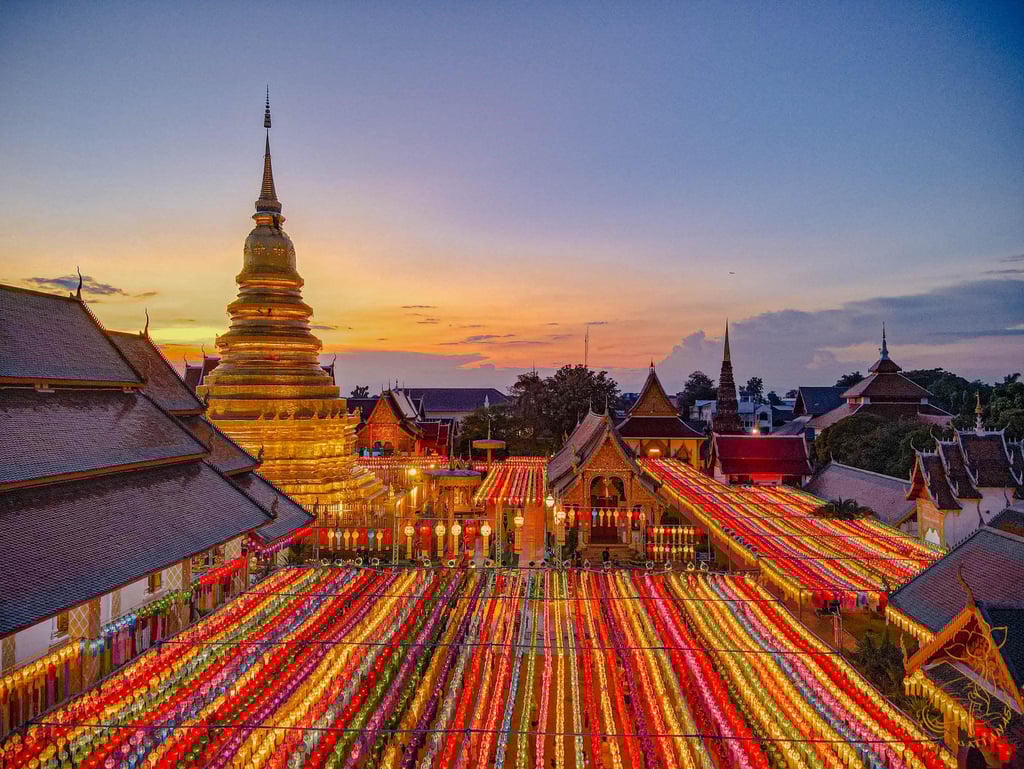
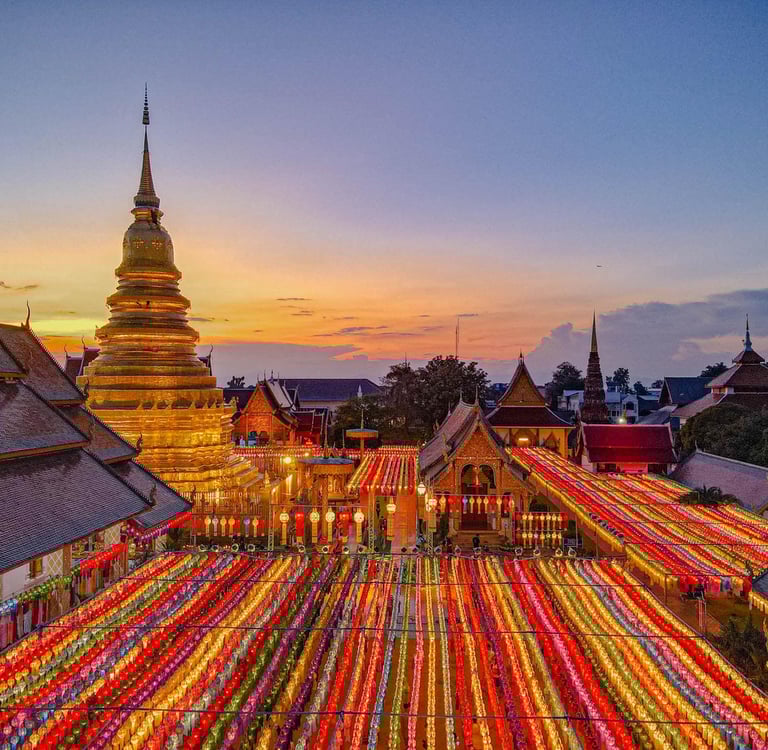
The Golden Chedi The central stupa (chedi) is a masterpiece. Standing 46 meters tall and covered in real copper plates topped with gold, it glows with an intensity that is breathtaking against a blue sky. It is said to contain a hair relic of the Lord Buddha.
The Gong of Luck In the temple courtyard, you will see an enormous bronze gong. It is said to be the largest in the world. Give it a gentle rub or a soft strike (if allowed) for good luck.
The Year of the Chicken In Northern Thai zodiac beliefs, specific temples are associated with specific birth years. Wat Phra That Hariphunchai is the pilgrimage site for those born in the Year of the Chicken. If that is you, paying respects here is believed to bring immense prosperity.
Part 3: The Warrior Queen – Wat Chamadevi (Wat Kukut)
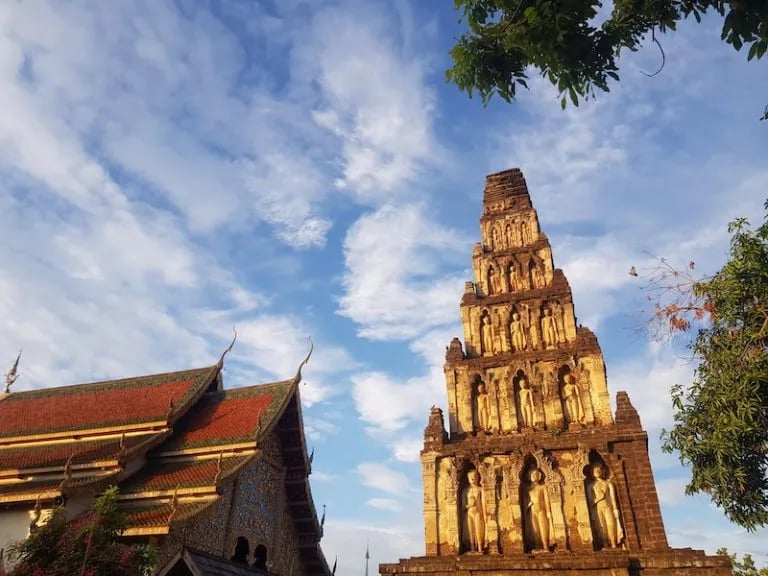
After the grandeur of the golden temple, take a short ride to the west of the city moat to visit Wat Chamadevi, locally known as Wat Kukut.
This temple feels different. It feels older.
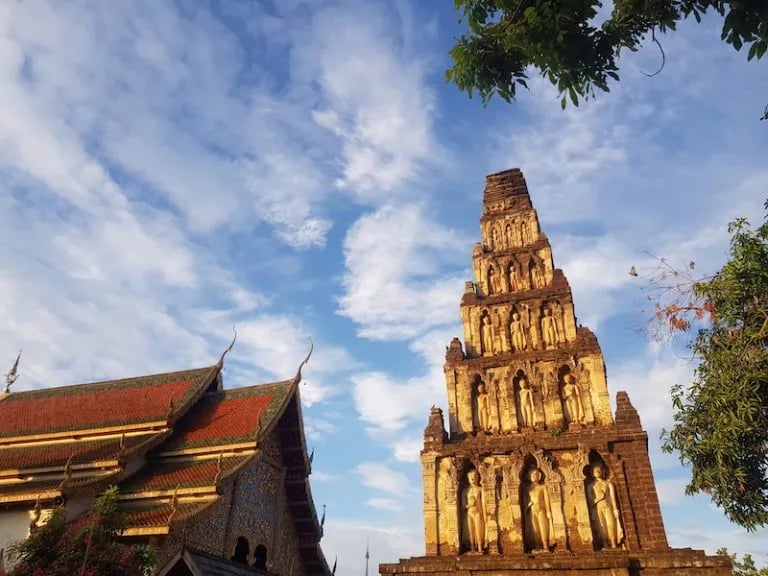
The Architecture The main chedi here is not the bell shape you see in Chiang Mai. It is a square, stepped pyramid, reminiscent of styles found in India or Polonnaruwa in Sri Lanka. Each of the five levels has niches housing standing Buddha statues—60 in total.
The Legend This temple is the final resting place of Queen Chamadevi, the first ruler of Hariphunchai. She was a warrior queen, a diplomat, and a deeply religious monarch who brought Buddhism to the north. Legend says she gave birth to twins who eventually succeeded her.
Walking around this temple, with its weathered brick and ancient stucco, you can feel the weight of 1,300 years of history. It is quiet, less crowded than the main temple, and perfect for meditation.
Part 4: A Taste of Lamphun – Longan Noodles
By now, you will be hungry. You cannot visit Lamphun without tasting its most famous export: Lamyai (Longan fruit).
Lamphun is the Longan capital of Thailand. While you can eat the fresh fruit, the local specialty dish you must try is Guay Tiew Lamyai (Longan Noodles).
What is it? It looks like a standard boat noodle soup with pork, but dried Longan fruit is added to the broth.
The Taste: The dried fruit gives the broth a subtle, natural sweetness and a deep, herbal aroma. It is surprisingly delicious and savory, not like a dessert!
Where to eat: Look for a shop called "Guay Tiew Moo Tun Lamyai" near the covered bridge tourist attraction (Khua Mung).
Part 5: The Elephant Shrine – Ku Chang Ku Ma
For a truly local experience, visit Ku Chang Ku Ma. This is not a typical Buddhist temple; it is an animist shrine dedicated to a war elephant.
The Legend of Poo Kum Nga Khiew According to legend, Queen Chamadevi had a powerful war elephant named "Poo Kum Nga Khiew" (The Dark Skinned, Green Tusked Elephant). He was said to have magical powers and helped her defend the kingdom.
When the elephant died, he was buried here. The stupa is cylindrical, unlike any other, and is believed to point toward the sky like an elephant's tusk.
The Vibe You will see locals offering sugar cane and bananas to the spirit of the elephant. It is a place of immense respect. It shows how Buddhism and Animism blend seamlessly in Thai culture.
Part 6: The Hariphunchai National Museum
If you want to escape the afternoon heat, head to the National Museum located just across the street from the main temple.
While small, it houses an incredible collection of Dvaravati art (the Mon period). You will see stone inscriptions, stucco Buddha heads with distinct Mon facial features (connected eyebrows, full lips), and artifacts that prove just how sophisticated this civilization was while Europe was in the Dark Ages.
Part 7: Returning Home and the Physical Toll
As the sun begins to set, casting long shadows over the ancient moat, it is time to head back to Chiang Mai.
You have had a wonderful day. You have walked through history. But let's be honest about what your body is feeling.
The "Temple Feet": You have taken your shoes off and put them back on at least 10 times. You have walked barefoot on hard tile and hot brick courtyards. Your arches are likely aching.
The "Heat Exhaustion": Lamphun is often a few degrees hotter than Chiang Mai. The tropical sun drains your energy levels.
The "Museum Back": Walking slowly and standing while reading history plaques is surprisingly tiring for the lower back and hips.
This is where the journey ends, and the recovery begins.
The Perfect End: Recovery at C and R Thai Massage
A day trip isn't complete until you have restored your body. When you arrive back in Chiang Mai, don't just collapse into bed with aches and pains. Treat your body with the same respect you paid to the ancient temples.
At C and R Thai Massage, we have specific treatments perfect for the "Post-Lamphun" traveler:
1. Thai Foot Reflexology (60 Minutes) This is the antidote to "Temple Feet." We begin with a cleansing herbal soak to wash away the dust of the ancient city. Then, we use traditional reflexology techniques to stimulate the energy points on the soles of your feet. This doesn't just relax the feet; it sends waves of relief up your legs and calms the entire nervous system.
2. Thai Herbal Compress Massage (90 Minutes) If the heat of the day has made you feel lethargic and stiff, the herbal compress is magic. We use a steamed ball of herbs (Plai, Turmeric, Lemongrass) and press it into your muscles. The heat penetrates deep into the tissue, drawing out toxins and relaxing the tightness in your back from the car ride.
3. Aloe Vera Massage (Sunburn Rescue) Did you forget your sunscreen while walking around the stupas? If your skin is feeling hot and red, our cooling Aloe Vera massage will soothe the burn and hydrate your skin instantly.
A Moment of Reflection While you are lying on our comfortable massage bed, smelling the scent of lemongrass and feeling the tension leave your body, take a moment to reflect on what you saw today. The resilience of Queen Chamadevi. The beauty of the golden stupa. The quiet dignity of the old trees.
Wellness is about connecting the past with the present, the mind with the body. By exploring Lamphun, you fed your mind. By visiting C and R, you honor your body.
Have you visited Lamphun? Did you try the Longan Noodles? Share your story in the comments below, or tell us about it when you come in for your massage!
Branch 1: Sunday Walking Street
(10 AM - 10PM)
Address: 145/8 Rajdamnern Road T. Prasingh
A. Mueng Chiang Mai 50200
Branch 2: Chiang Mai Gate
(10 AM - 10PM)
Address: 18/5 Rat Chiang Saen Road T. Hai Ya
A. Mueng Chiang Mai 50100
Phone Number:
+66 (0) 94 601 6207
+66 (0) 83 480 2627
Email: services.crgroup@gmail.com