




Sankamphaeng & Bo Sang Shopping Guide: The Handicraft Highway
Explore the Handicraft Highway in Chiang Mai. A complete guide to shopping in Sankamphaeng & Bo Sang Umbrella Village, plus post-shopping massage tips.
CHIANG MAI OLD TOWN AND TRAVEL TIPS
12/22/20257 min read
The "Handicraft Highway": A Guide to Shopping in Sankamphaeng & Bo Sang (The Umbrella Village)
Chiang Mai is often called the creative capital of Thailand. But where does all that creativity come from? If you trace the silk scarves, the painted umbrellas, and the celadon pottery back to their source, they all lead to one place: Highway 1006.
Stretching east from the city, this road is better known by its nickname: The Handicraft Highway.
For centuries, the villages of Sankamphaeng and Bo Sang have been the beating heart of Lanna craftsmanship. This isn't just a shopping district; it is a living museum. Behind every shopfront is a workshop where skills have been passed down from grandmother to granddaughter, father to son, for generations.
At C and R Thai Massage, we see a deep connection between the artisan’s hands and the therapist’s hands. Both require patience, tradition, and a touch that can only be learned through feeling. We also know that a day spent walking this highway—exploring factories, painting umbrellas, and carrying bags of treasures—can be physically exhausting!
This guide is your roadmap to the best of Sankamphaeng. We will take you beyond the tourist traps to the authentic workshops, help you distinguish real silk from synthetic, and show you how to turn a shopping trip into a cultural immersion.
Part 1: Bo Sang – The Village of Umbrellas
Your first major stop, about 9km from the city, is Bo Sang. You will know you have arrived because the street signs, bus stops, and even the archway are decorated with giant, colorful umbrellas.
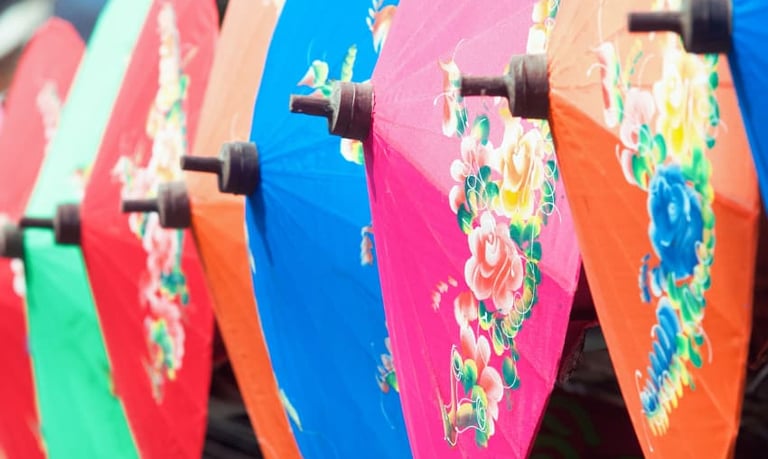
The Legend of the Umbrella Monk Legend has it that a local monk named Phra Intha traveled to Myanmar hundreds of years ago. There, he saw people using umbrellas made of oiled mulberry paper (Saa paper) to protect themselves from the sun and rain. He brought the technique back to Bo Sang, and the villagers, who had plenty of bamboo and mulberry trees, began to make them during the farming off-season.
What to Do:
The Bo Sang Umbrella Making Centre: This is the hub. It sounds touristy, but it is a must-visit. You can walk through the open-air workshop and see the entire process.
Step 1: Watching the men whittle bamboo into delicate ribs.
Step 2: Seeing the women arrange the Saa paper pulp.
Step 3: The painting. This is the highlight. The artists here are incredibly fast and skilled.
Get Your Own "Tattoo": You don't have to buy an umbrella to enjoy the art. For a small tip (usually 50-100 Baht), the artists will paint a stunning design on your phone case, your jeans, your bag, or even your arm! It dries in minutes and makes for a unique souvenir.
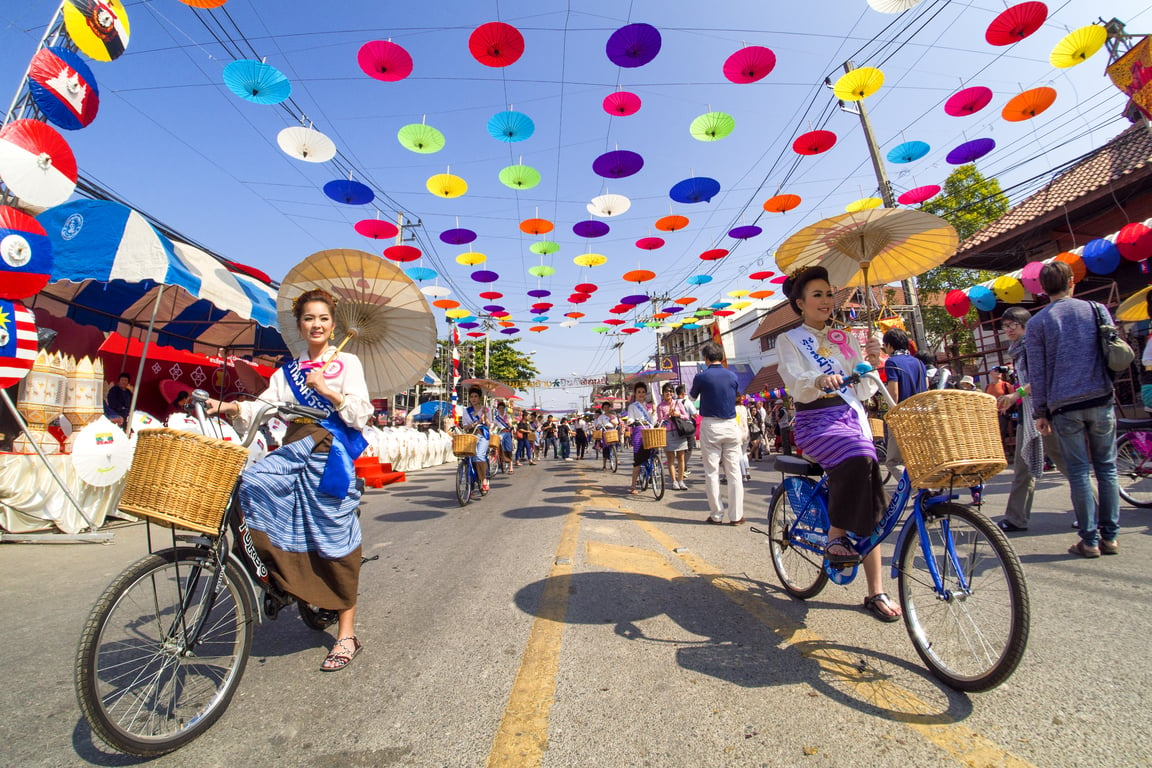
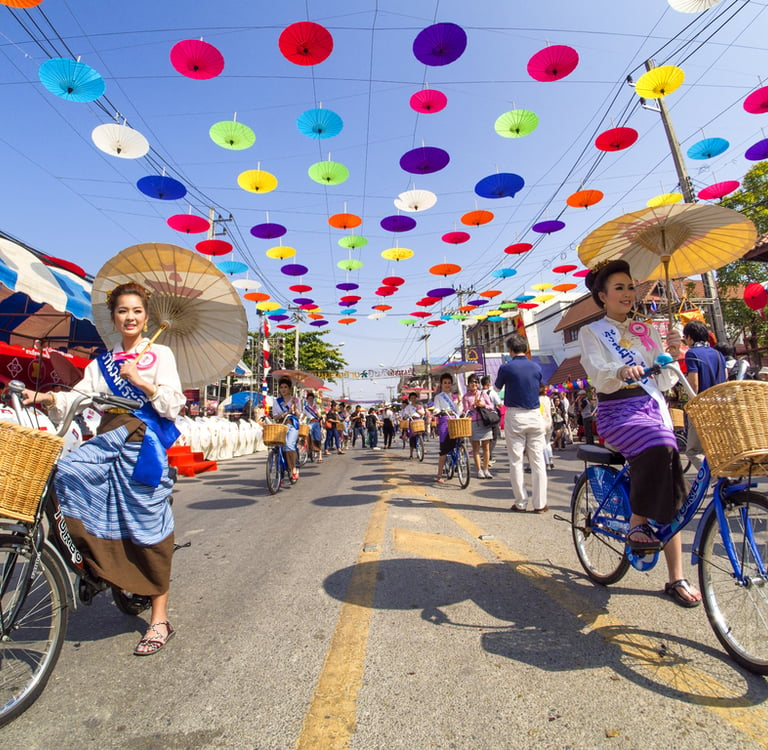
The Festival: If you are lucky enough to visit in January, the Bo Sang Umbrella Festival takes over the streets. It is a riot of color, with parades of bicycles ridden by ladies holding umbrellas, lantern competitions, and beauty pageants.
Part 2: The Art of Thai Silk (Sankamphaeng)
Continuing down the highway, you enter the land of silk. Thai silk is famous worldwide for its luster and slightly rougher texture compared to smooth Chinese silk.
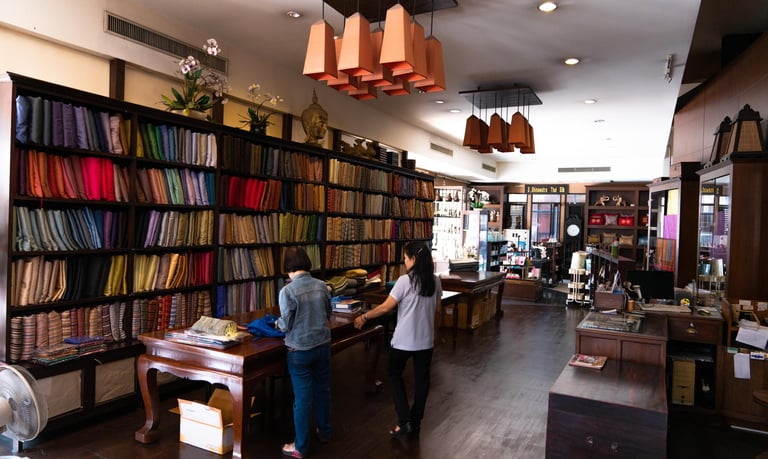
Shinawatra Thai Silk This is the oldest silk factory in the area. The building itself is a beautiful example of Lanna architecture.
The Experience: You can see the entire lifecycle of silk here. It starts with the yellow silkworm cocoons bubbling in hot water. You watch as a single, incredibly thin thread is pulled from the cocoon. Then, you see the looms. The clack-clack-clack sound of the wooden looms is the heartbeat of Sankamphaeng.
How to Spot Real Silk:
The Burn Test: Ask for a loose thread. If you burn it, real silk smells like burning hair (protein). Synthetic polyester smells like burning plastic.
The Sound: Rub the fabric together. Real silk makes a crunching sound (called scroop). Synthetic silk is silent.
The Look: Real silk shimmers and changes color slightly in different lights (iridescence). Synthetic silk has a flat, white shine.
Part 3: Celadon Pottery (The Green Gem)
"Celadon" refers to a specific type of stoneware with a jade-green glaze. This technique was introduced to Thailand from China during the Sukhothai period, but Northern Thailand made it its own.
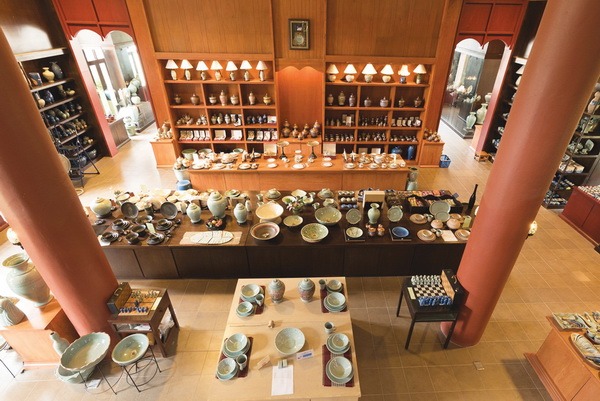
Baan Celadon / Siam Celadon These large showrooms/factories are museums in their own right.
The Process: The distinctive green color comes from wood ash in the glaze. When fired at high temperatures, the glaze cracks underneath the surface. This "crazing" or crackled look is the signature of true Celadon.
What to Buy: A simple Celadon tea set or a vase is a timeless piece of decor. It is heavy, durable, and looks far more expensive than it is.
Note on Shipping: These factories are experts at shipping. If you fall in love with a giant elephant statue or a dinner set for 12, do not worry about carrying it. They offer insured international shipping (usually DHL) right from the shop floor.
Part 4: Lacquerware & Silverware
Lacquerware (Kruang Kern) This is a lesson in patience. Lacquerware starts with a bamboo or wood base. It is then coated with layer upon layer of lacquer (sap from the Rhak tree). Each layer must dry and be polished before the next is applied. Finally, it is painted with gold leaf. The result is a glossy, black-and-gold masterpiece.
Where to look: Laitong Lacquerware. Watch the artists applying the gold leaf with delicate brushes. It is mesmerizing.
Silverware (Louis Silver) Chiang Mai silver is renowned for having a high purity (often close to 100%, higher than Sterling's 92.5%). Because pure silver is soft, it allows for incredible repoussé work (hammering designs from the back).
The Vibe: Walking into a silverware showroom feels like entering a dragon's hoard. The detail on the silver bowls, depicting scenes from the Ramakien epic, is staggering.
Part 5: Beyond the Factories – MAIIAM Contemporary Art Museum
Sankamphaeng isn't just about traditional crafts. It is also home to the coolest modern building in Chiang Mai.
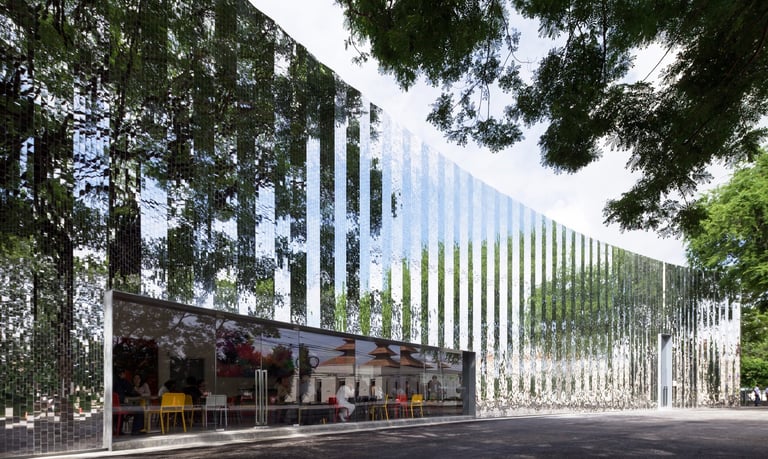
MAIIAM You cannot miss it. The front of the building is a giant wall of mirrors that reflects the passing traffic and trees. Inside, it is a world-class gallery housing the private collection of the Bunnag-Beurdeley family.
Why go: It provides a stark, refreshing contrast to the ancient crafts you have seen all day. The art is political, emotional, and cutting-edge. It shows that Thai creativity is not stuck in the past; it is evolving.
The Cafe: They have an excellent cafe serving fusion food, perfect for a lunch break.
Part 6: Shopping Strategy & Etiquette
Navigating the Handicraft Highway can be overwhelming. Here are some tips to survive:
Transport: The easiest way is to hire a red truck (Songthaew) or a Grab driver for a half-day. Negotiate a price for them to wait for you at each stop. Do not rely on finding a new taxi at every factory; they are spread out.
Bargaining: In the large factories with price tags, bargaining is less common than in the night markets. However, if you are buying multiple items, you can politely ask for a "special price." In the smaller village shops in Bo Sang, friendly bargaining is expected.
The "Commission" Reality: Be aware that some drivers will push you to visit specific gem or jewelry factories because they get a commission (or a fuel voucher). If you aren't interested, be firm but polite: "No jewelry today, only silk and wood, please."
Part 7: The "Shopper’s Syndrome" (And How We Fix It)
Shopping is a sport. After 4-5 hours on the Handicraft Highway, your body will feel it.
The "Museum Walk": That slow, shuffling walk you do while looking at shelves is actually terrible for your lower back. It tires out the stabilizer muscles without engaging the big movers.
The "Shopping Bag Shoulder": Carrying heavy ceramics or bags of silk on one shoulder throws your spine out of alignment and causes tension headaches.
The "Heat Fatigue": Walking in and out of air-conditioned shops into the tropical heat confuses your body’s temperature regulation, leading to exhaustion.
The C and R Recovery Plan When you return to the city with your treasures, do not just collapse. Come see us for a "Shopper's Recovery" session.
Thai Foot Reflexology (60 Minutes): This is non-negotiable. Your feet have swollen from the heat and the standing. We will use a cooling menthol balm to reduce the swelling and stimulate blood flow. You will feel the "heaviness" drain out of your legs.
Head, Back, and Shoulder Massage (60 Minutes): We focus on the trapezius muscles (where you carried your bags) and the lower back (from the slow walking). We use firm thumb pressure to release the trigger points that cause headaches.
Aromatherapy Oil Massage: If the heat has made you feel drained, a relaxing oil massage with a refreshing scent like Lemongrass or Eucalyptus can help reset your energy levels for dinner.
Conclusion: Bringing a Piece of Lanna Home
A trip to Sankamphaeng is more than just shopping. It is an education. When you buy a hand-painted umbrella or a piece of Celadon, you aren't just buying a souvenir; you are supporting a lineage of artisans. You are keeping a culture alive.
Every time you look at that vase on your shelf back home, you will remember the heat of the kiln, the smell of the mulberry paper, and the smile of the artist who painted it.
And hopefully, you will also remember the feeling of total relaxation that followed, as you lay on a massage bed at C and R Thai Massage, resting your tired feet and reflecting on a day well spent.
What is the best treasure you have ever found in Chiang Mai? A silk scarf? A silver bangle? Tell us in the comments!
Branch 1: Sunday Walking Street
(10 AM - 10PM)
Address: 145/8 Rajdamnern Road T. Prasingh
A. Mueng Chiang Mai 50200
Branch 2: Chiang Mai Gate
(10 AM - 10PM)
Address: 18/5 Rat Chiang Saen Road T. Hai Ya
A. Mueng Chiang Mai 50100
Phone Number:
+66 (0) 94 601 6207
+66 (0) 83 480 2627
Email: services.crgroup@gmail.com